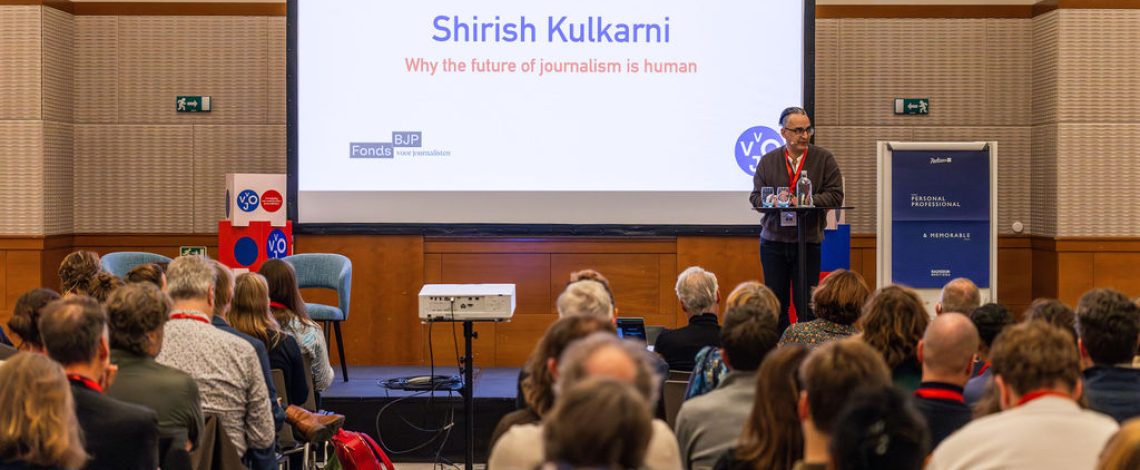
Good morning, welcome, and thank you to VVOJ for inviting me to be here this morning. It’s a real pleasure for me to be here, because I have lots of friends here in Belgium and The Netherlands, and this is actually my second time speaking at this conference. I think that says a lot about the work you’re all doing, and the work that organisations like VVOJ, FondsBJP, SVDJ and others are doing. What I think that’s led to is a really notable culture here of being open to new ideas, challenging received wisdom and doing everything you can to make sure journalism really makes a difference. In my experience, that is rarer than we would want and hope, so it’s a privilege to be able to share in that culture with you, and perhaps even contribute to it a little bit.
So, as I say, there are lots of familiar faces here, but for those of you I’ve not had the pleasure of meeting, I should just introduce myself. I describe myself these days as a journalist, researcher and community organiser. I spent more than 20 years working in all the UK’s major broadcast newsrooms, in almost every job: from being a cameraman/editor on the road, to directing and vision mixing programmes, to programme editing network news.
I then went into investigations, both as a freelancer and then at The Bureau of Investigative Journalism – the biggest non-profit investigative journalism newsroom in the UK.
But over the last 6 or 7 years I’ve mostly been working mainly as a researcher, figuring out how we can make journalism work better for people and communities, crucially, by listening to them. And, as you embody here in Belgium and the Netherlands, being open to new ideas, challenging received wisdom and doing everything I can to make sure journalism really makes a difference.
1. Good news or bad news?
So, the theme of this year’s conference is The Uncomfortable Reality which means that as the Keynote speaker, I’m basically contractually obliged to make you feel at least a little bit uncomfortable. It won’t all be discomfort though, I promise, because I truly believe that this is also a story of hope.
But let’s start with the bad news.
2. The bad news, part one: the model has gone
Put simply, journalism as we’ve understood it for the last 200 years or so, doesn’t work any more. That’s not an opinion. That’s a reality based on simple economic principles. That’s because the traditional business of journalism rested on two things: scarcity of information and costs of distribution.
Information used to be very scarce. If I wanted to know what was happening in the next town, let alone on the other side of the world, I had to rely on newspapers, and eventually broadcasters. They had the reporters on the ground, the access to people in power, and the licences to broadcast. They decided what counted as news, and there was no other way to find out.
And getting that news to people was expensive. Printing presses. Delivery vans. Transmitters. Even 20 years ago, when I was out on the road as a cameraman, getting a story on air took a building full of people and kit that cost millions. That cost was a moat. It kept others out, and it brought the money in.
So the business of journalism worked because of scarcity of information and costs of distribution. But guess what? Neither of those things exists any more. Information isn’t scarce, it’s infinite. Distribution isn’t expensive, it’s free. The moat has gone.
Now, another uncomfortable reality particular to investigative journalism is that it’s never really paid for itself. It was paid for by the classified ads, the property supplements, the sports results. It was the slow, expensive, unglamorous work the rest of the business carried, because it gave the whole thing its reputation. So when the rest of the business collapsed, that subsidy collapsed with it. That, fundamentally, is why so many of us work for non-profits, or freelance, or hold down three jobs to pay for the one we actually care about. I’m all three of those, and I’m sure many of you are too. Those are the simple economic facts.
You know all this. Ironically, this bit is not news.
3. The bad news, part two: content is now almost worthless
But here’s the new bit, and it’s economics again.
In an AI-mediated world, most content has almost no marginal value. A machine can write an 800-word, inverted pyramid news story, better than I can, right now. Not in 5 years time or 10 years time, right now. And then it can create a summary, an explainer, an Instagram post and a video in seconds, for next to nothing.
And it can take your story, the one that took eighteen months, three freedom of information appeals and a costly legal case, and boil it down to three lines in a chatbot answer. Possibly accurate. Almost certainly without a link back to you.
What that means is central to how we reimagine the future of journalism. If a machine can produce another story, another summary, another video, endlessly, for almost nothing, then content isn’t scarce any more. It’s infinite. And anything there’s an infinite supply of is worth almost nothing. That’s not a judgement about quality. Again, it’s just basic economics.
So if what we sell is content, we’re now selling the one thing the world has an endless supply of.
4. The bad news, part three: our theory of change is broken
And here’s the really uncomfortable bit.
Investigative journalism has a theory of change, even if we don’t often say it out loud. It goes something like this. We find out something hidden. We expose it. The public sees it, gets angry, and demands action. And the powerful are held to account.
Expose. Outrage. Accountability.
If I’m honest, I’m not sure if that theory of change has ever worked quite as neatly as we believed, or hoped, it did. But now every step of that relies on things we can no longer take for granted.
It relies on people trusting us. Trust in news globally is now 37 per cent, the lowest the Reuters Institute has recorded since it started measuring.
It relies on people paying attention. Instead, more and more people actively avoid the news, because it leaves them feeling anxious and powerless.
And it relies on people believing that if they do get angry, something will actually change. That their anger has somewhere to go.
I said at the start that this community does everything it can to make sure journalism really makes a difference. This is exactly where that gets hard.
Over the last year, I’ve been doing some deep listening work in Blaenau Ffestiniog, an old slate mining town in the mountains of North Wales. During that work, one of our community partners told me something I take very seriously. Whatever divides people in a town like that, he said, “what unifies everyone is that we’re all worried.” People told us the town feels left behind, and a long way from power.
And when we asked people to write a letter to a loved one about the experience, one participant wrote: “I don’t trust the news now… it’s surprising the amount of people who all feel the same – an anti-news revolution you might say!”
Worried. Powerless. Distrustful. An anti-news revolution. That’s the real world outside this room.
So here’s the uncomfortable reality as I see it. We can do everything right. We can get the documents, verify every fact, survive the lawyers, and publish something that’s true and important. And it can land somewhere people don’t trust it, don’t see it, or don’t believe that knowing it makes any difference.
Getting the truth out isn’t enough. Information without the conditions for people to make sense of it, and act on it, goes nowhere.
And here’s the part that’s hardest to hear, and I include myself in this: some of that distrust, we’ve earned. Too often our relationship with communities has been extractive. We parachute in. We take the story, the quotes, the pain. We leave, and we decide what it all meant somewhere else. The people we took it from rarely see what happens next. Investigative work risks being the most extractive of all, because the stakes are high and a source can easily become a means to an end.
Let me tell you a story, from my own experience, which perhaps illustrates both sides of this.
The thing I’m proudest of in my career is uncovering what became known as the British Steel Pensions Scandal. Nearly eight thousand steelworkers were persuaded to transfer £2.8 billion – so more than 3 billion euros – out of a secure pension scheme. Many of them were pushed into it by advisers who earned big fees, and lost money they’d spent their working lives earning.
By every measure we usually use, the investigation worked. The reporting led directly to a parliamentary inquiry, and to a ban on pensions cold calling. It got a name. With “scandal” in it. That’s like the holy grail for an investigative journalist, right?!
Although the regulator found almost half of those steelworkers were given unsuitable advice, years later, the independent Complaints Commissioner concluded that, even after a compensation scheme, they still haven’t been put back where they would have been.
So even when we do everything right, and the system responds, much of the harm stays where it landed. That’s the uncomfortable reality too. But it isn’t the end of that story, and I’ll come back to it.
But I did promise you some good news too.
5. The good news: what’s scarce now is human
If content is infinite, the really important question becomes: what’s still scarce? What’s still worth something?
And the answer is, obviously, the stuff a machine can’t do, what a machine will never be able to do. The uniquely human things – what I sometimes summarise as: Connection. Collaboration. Care.
Now, I want to be clear, because this is usually the point where people decide, I’m just about the cute, fluffy stuff and I don’t understand the realities of journalism. They think I’m just an AI sceptic so they can ignore anything which follows. I’m absolutely not. Five years ago, before ChatGPT even existed, I was a coach on the JournalismAI programme at Polis, at the London School of Economics. On that programme, I was helping newsrooms work out what AI could do for them, and was also one of the first to develop the concept and practice of modular journalism – what some people now call liquid content.
So, I’m not saying this as a sceptic, but it’s precisely because I understand the strengths and limitations of AI that I’m convinced it isn’t a silver bullet. Of course it’s extraordinarily good at producing content. But producing content was never the hard part.
A chatbot can summarise a thousand documents. It can’t sit at someone’s kitchen table for three hours while they decide whether to trust you. It can’t notice what someone isn’t saying. It can’t show up again next week, and the week after that. It can’t be in a room where people disagree and help them find what they share.
And people know the difference. That same Reuters report that I talked about earlier found only one in five people trust news from AI chatbots, yet many news organisations are throwing themselves headlong into AI. For some reason, they still don’t see the fundamental economic reality. Trust is the scarce thing now. And trust is built between humans – at the kitchen table, in the community centre, face to face. Not on a server in a data center.
So the innovation we need isn’t just in what we publish, or what technology we use. It’s in who we listen to, and how we listen.
6. What communities told us
Let me tell you how I got here, because this isn’t a theory. It came from communities telling me exactly what they want and need from journalism.
Before that project in North Wales, where we worked with S4C, the Welsh-language public broadcaster, we did a similar piece of work in Grangetown, a diverse inner-city neighbourhood in Cardiff, working with BBC News.
Two places that couldn’t be more different. One urban, multi-ethnic, mostly English-speaking. One white, rural, high in the mountains, mostly Welsh-speaking. And they told us remarkably similar things.
We didn’t start with surveys or focus groups. We started with creativity. My friends Rhiannon White, who’s a theatre maker, and Silvia Rose, who’s a writer, led creative sessions designed to bring people into a more open, honest headspace before we asked them anything at all. In Blaenau that meant dancing, badly, at ten o’clock on a Saturday morning – we literally had a mini-rave in order to get people to feel uncomfortable with each other, as a way of getting them to feel comfortable with each other. We wrote poems in the voice of the town, we went out in the streets to ask strangers, “What does Blaenau need?”
Nobody looks cool dancing at 10am. Not the retired teacher, not the teenager, not the commissioning editor from the national broadcaster. And that’s the point. Shared awkwardness strips out status. People stop relating to each other through their job titles and start talking as neighbours.
So people told us things they’d never tell a focus group. Including the almost universally felt realisation that “There’s nowhere to buy knickers in Blaenau!” You can laugh, and we did. But that’s what a town losing its everyday infrastructure feels and sounds like.
So what did we learn? Not that people wanted more news. Not more content, in more formats, on more platforms. They wanted somewhere to make sense of things together. Places to meet, talk, disagree, and work out what’s going on and what to do about it. One participant, Eva, described what we’d made as a “shared processing space”.
Information was never really the missing ingredient. What was missing was the processing layer: the human, collective work of turning information into understanding, and understanding into action. No algorithm does that for a community. People do it with each other.
And then something happened that I didn’t expect. People started acting. Community members began planning a food exchange, a café and a sense-making hub, to meet needs they’d identified themselves. Nobody told them to. They’d been given the space to work it out, and they did. Isn’t that what journalism is really for, to help people and communities live better lives together?
7. Why this room is better placed than anyone
So here’s the good news, for you specifically. Of everyone in journalism, investigative journalists might be best placed to do this. Because you already know how.
You know that trust takes time. You’ve spent months, sometimes years, building a relationship with a single source before they’d tell you what they knew. You know the most important thing someone says is often the thing they nearly didn’t say. You know how to listen for it.
I didn’t find the British Steel pensions story in a leak or a document dump. I found it by making hundreds of phone calls. I’ll be honest, I used to think investigative journalists had skills I didn’t have. I put them on a pedestal and thought that would never be me. But then I discovered the truth. It turns out investigative journalists are just the people who carry on when everyone else stops.
And when I finally found a steelworker in Port Talbot who’d talk to me, the reason he did was that I gave him the option not to. I didn’t push. I put his wellbeing ahead of the story, every time.
Remember I said the harm stayed where it landed? Afterwards, the steelworkers didn’t talk to me about money. They said it felt like they’d been given power back. Power that had been taken away from them, and had left them feeling helpless. That was the thing that was most important to them.
That’s what our work is for. Not just exposure. Giving people back their power to act.
You know how to collaborate. This community, with its cross-border investigations, shared datasets and networks, has done more than almost anyone to prove journalism doesn’t have to be a lone genius in a locked room. You’ve seen it right here: Apache and Follow the Money working across the border on the ports of Antwerp and Rotterdam. Two countries, two freedom of information systems, one story.
And you know what care looks like, because you’ve had to look after people who took real risks to talk to you.
What I’m asking is that we turn those skills outwards. That we offer communities the same patience and care we already give our best sources.
What might that look like in practice?
Listen before there’s a story. Treat people as co-investigators, not just sources. Start with what’s right with a place, not only what’s wrong with it. Stay after publication. And make space for people to make sense of our work together.
None of this is soft. It isn’t a retreat from hard-edged journalism. It’s how hard-edged journalism actually lands, and how exposure turns into accountability.
I said at the start that you’re unusually good here at challenging received wisdom. So here’s one I’d ask you to challenge: that our job is done when we publish. It isn’t. Making a difference starts with who we listen to, and how we listen. And it doesn’t stop when the story goes out.
8. Remembering what it’s for
For a long time, we got very good at producing and distributing content, because that’s what paid. And we started to believe the content was the point.
It never was. The point was always people understanding their world well enough to change it.
So here’s the uncomfortable reality, one last time. The thing that paid for journalism has gone, and it isn’t coming back. A machine can now do much of what we used to sell.
But it can’t do what journalism is for.
It can’t sit at a kitchen table. It can’t earn trust. It can’t dance badly on a Saturday morning with strangers who end up planning a food hub together. It can’t care.
The future of journalism isn’t content. It’s connection.
That’s why the future of journalism is human. Not because humans write better than machines. Increasingly, we don’t. It’s because the things that matter most in our work are the things that make us human.
And I’ll confess something. I’m an idealist. Always have been, always will be. And I suspect most of you are too. I didn’t become a journalist for the money, or the hours. I became a journalist to be part of making the world a better place.
Somewhere along the way, the business got in the way of that. We started counting clicks and reach and page views. But connection, collaboration and care aren’t a new business model. They’re the reason most of us came into this in the first place.
So the human stuff isn’t a distraction from serious journalism. It takes us back to why we started.
So this isn’t the end of journalism. It’s a chance to remember what it’s for.
On the last day in Blaenau, one participant wrote a poem in Welsh. They wrote about feeling a mix of “positive despair and hopeless positivity”. And then they wrote that our community “deserves better. Deserves the best!”
They do. So do yours. Let’s go and listen to them. Let’s hear some uncomfortable truths and turn them into a new/old journalism. A journalism that’s fit for the future. A journalism that’s uniquely human.
Thank you.
De keynote werd ondersteund door een bijdrage van het Fonds Bijzondere Journalistieke Projecten.